
Coming home to Auckland and finding your goods held by Customs is a frustrating end to any trip. It happens more often than people think, and it is not just smugglers or big spenders who get caught out. Plenty of honest travellers have their own laptop, camera, tools or jewellery held because they cannot prove they owned it before they left New Zealand.
This guide explains why goods get held by Customs at the border, how the NZ$700 duty free concession works, what you can do before you travel to avoid problems, and how a licensed customs broker like Sneddens can help you get your held goods released, often without paying GST you never owed.
Why Goods Get Held by Customs at the Airport
When you arrive in New Zealand, anything you bought or were given overseas counts towards your duty free concession. According to New Zealand Customs, you will have to pay GST and duty if you bring in more than NZ$700 in total of goods bought overseas or duty free, including gifts. If you are travelling with other people, you cannot combine your NZ$700 concessions.
Do not confuse this with the NZ$1,000 threshold you may have heard about. That applies to goods you buy online or have sent by post, courier or freight, not to goods in your luggage. For travellers, the limit is NZ$700, and going over it is one of the most common reasons for goods held by Customs at the airport.
The problem for many travellers is the grey area in between. You leave the country with an expensive item you already own, and when you come back an officer asks whether it was bought overseas. If you cannot show it was yours before you left, Customs may treat it as a new purchase and ask you to pay GST and any duty, or hold the goods until the question is resolved.
Common items that get questioned
- Laptops, tablets and high end phones
- Cameras, lenses and drones
- Watches and jewellery
- Professional tools and equipment
- Sporting gear such as golf clubs, e-bikes and dive equipment
How to Avoid Having Your Goods Held by Customs
The best fix is preparation. A few minutes before you fly can save you hours at the border and a GST bill on something you already paid tax on in New Zealand.
1. Get a Certificate of Export for valuable items
New Zealand Customs offers a Certificate of Export for expensive equipment such as a laptop or camera. Your item must be uniquely identifiable, for example with a serial number, and you present it at a Customs office before you leave. Customs says the certificate will make bringing your item back into New Zealand simpler, and that otherwise you might have to pay Customs duty and/or GST on it. Check beforehand, as there may not be a Customs office at your place of departure.
2. Carry proof that you bought it in New Zealand
If you do not have a Certificate of Export, Customs recommends you keep receipts or other proof you already owned the item. A copy of your NZ receipt, a bank or card statement, a warranty registration or an insurance schedule saved on your phone is a simple habit that makes a real difference if you are questioned.
3. Declare honestly on your Traveller Declaration
If you are unsure whether something needs declaring, declare it and talk to the officer. Undeclared goods can lead to penalties, and it is far easier to explain an item up front than after it has been found.
4. Pre clear commercial goods before you travel
If you are carrying goods for business, such as samples, stock or equipment for a job, talk to us before you fly. As your customs broker, Sneddens can prepare the paperwork in advance so the goods can be cleared properly when you land instead of being held at the airport.
What Happens When Your Goods Are Held by Customs
If Customs decides goods need further assessment, they can be detained at the border rather than released to you on the spot. You will be given a Receipt for Detained Goods, the official NZ Customs form most people call a bag tag notice. It records the goods, their assessed value and a unique reference, and states that the goods are detained pending payment of duty under sections 129 and 135 of the Customs and Excise Act 2018. Keep it safe. It is the key document a customs broker needs to deal with Customs on your behalf.
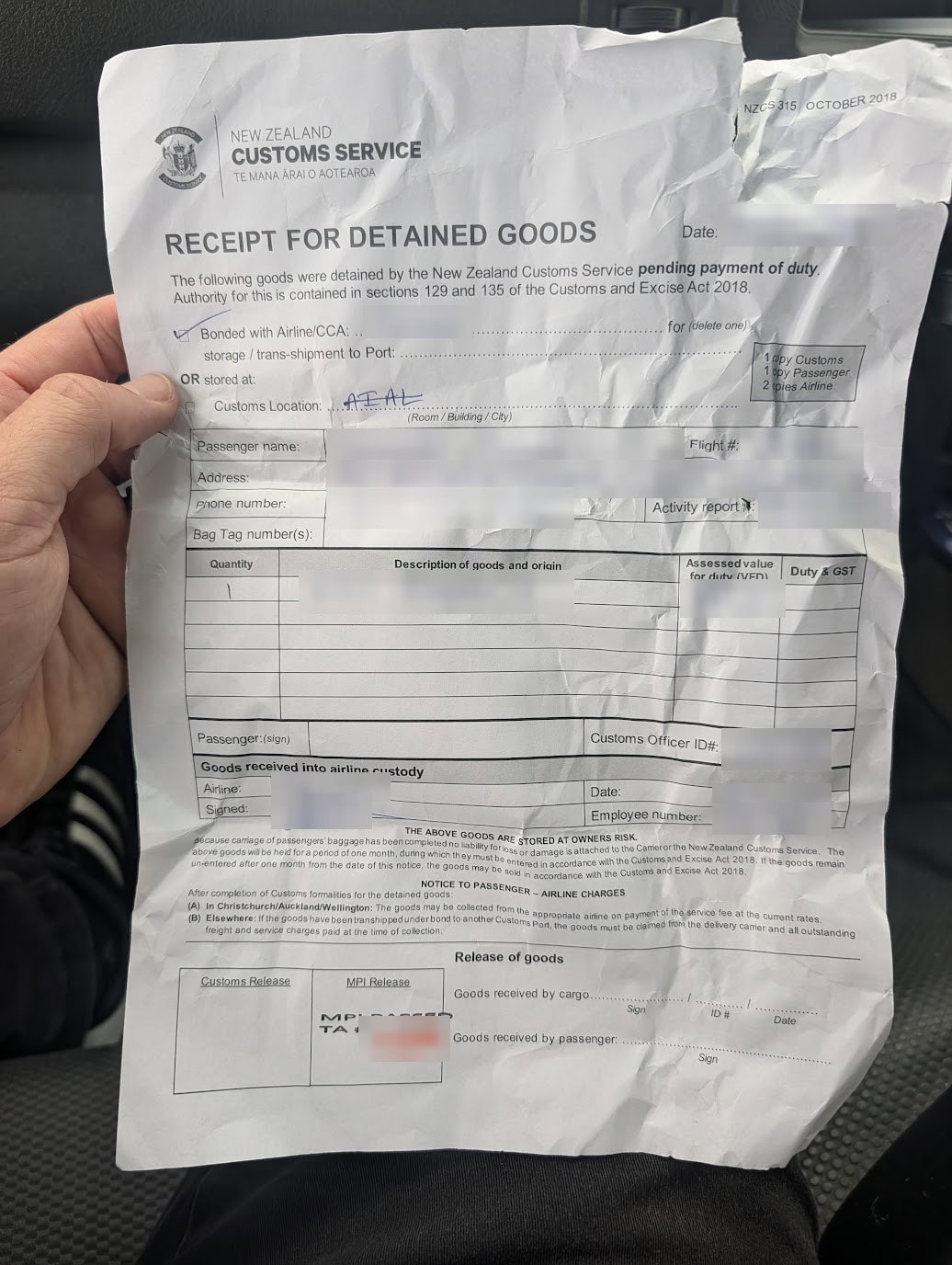
The receipt also sets out the costs and the deadline. Detained goods are stored at the owner’s risk, usually in airline custody, and are held for one month. If they have not been entered within one month of the notice, they may be sold under the Customs and Excise Act 2018. When you collect them in Auckland, Christchurch or Wellington, the airline charges a service fee at its current rates, so the longer it takes, the more it costs. If you have goods held by Customs, acting quickly matters.
How a Customs Broker Gets Held Goods Released
Clearing goods held by Customs is customs broker work. At Sneddens, our licensed customs brokers handle this for travellers regularly. Here is how it typically works:
- Send us your bag tag notice. The Receipt for Detained Goods identifies your goods and lets us deal with Customs on your behalf.
- Provide your documents. Along with the bag tag notice, we need your e ticket, your passport and a commercial invoice or receipt for the goods. If you do not already have one, we can also apply for a Customs client code for you.
- Gather your evidence. Receipts, bank statements, photos with dates, warranty records or anything else showing the item was yours before you left New Zealand.
- We make the case to Customs. Our broker presents the evidence and lodges what is needed to clear the goods.
- Your goods are released. Once cleared, we arrange collection or delivery and keep storage costs to a minimum.
For goods held by Customs, where the evidence shows the goods were yours before you travelled, they should not attract GST as a new import. That is often the biggest saving for travellers, on top of avoiding extra days of storage.
Why Use a Boutique Freight Forwarder Like Sneddens?
Large logistics companies are built for container loads, not one held suitcase. Many will not take on a single traveller job at all. Sneddens is a boutique, Auckland based freight forwarder and customs broker with more than 20 years in the industry, so we have the time and the know how to help with smaller, personal clearances as well as commercial freight.
- Licensed customs brokers who deal with NZ Customs every day
- Fast, personal service when goods are held by Customs at Auckland Airport
- Help with evidence so you are not paying GST you do not owe
- One team for air freight, importing and customs clearance
If you are moving your whole household, shipping a vehicle or importing for business, the same team can help. See our guides on how to ship your car overseas and importing into New Zealand.
Frequently Asked Questions About Goods Held by Customs
What is the duty free concession in New Zealand?
New Zealand Customs allows each traveller NZ$700 in total of goods bought overseas or duty free, including gifts. Above that, GST and duty apply. Travellers cannot combine their concessions.
Do I need to declare a laptop I took overseas?
You do not need to declare personal items when you leave. When you return, Customs recommends you carry a Certificate of Export or receipts showing you already owned valuable items like laptops and cameras.
What is a Certificate of Export?
It is a Customs document proving you owned an item before leaving New Zealand. The item must be uniquely identifiable, such as by serial number, and you present it at a Customs office before you depart.
How do I get goods held by Customs released?
Contact a licensed customs broker with your bag tag notice (the Receipt for Detained Goods), your e ticket, passport and a commercial invoice or receipt for the goods. The broker deals with Customs on your behalf and can apply for a Customs client code if you need one.
How long will Customs hold my goods?
Detained goods are held for one month and stored at the owner’s risk. If they are not entered within one month of the notice, they may be sold under the Customs and Excise Act 2018. Airline service fees apply on collection, so it pays to act quickly.
Goods Held by Customs? Talk to Sneddens Today
If your goods have been held by Customs, do not leave them sitting in storage. Call Sneddens on 0800 76 33 33 or get in touch online with your bag tag number, and our customs brokers will take it from there.