
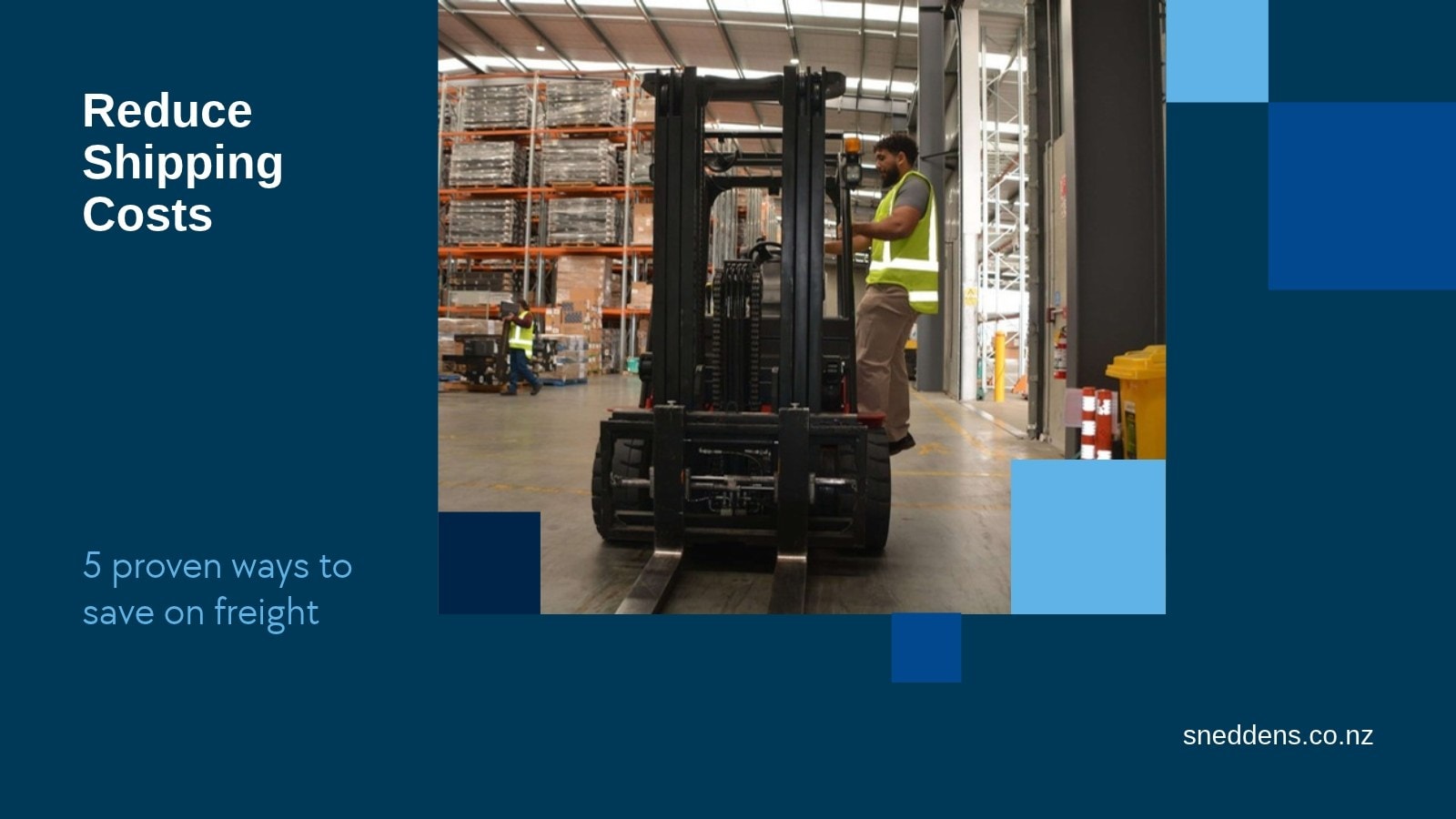
Want to reduce shipping costs? Whether you are in manufacturing, retail or wholesale, freight is often one of the biggest costs of running your business, and fuel, labour and capacity keep pushing prices around. A good freight forwarder works as the conductor of your supply chain, finding the most cost-effective way to get goods to you or your customers on time. Here are five ways to reduce shipping costs.
1. Control your buying terms (Incoterms)
When you negotiate a sales contract, the Incoterms you agree decide who pays for each part of the journey. For imports, buying on terms such as FOB (Free On Board), where your supplier delivers the goods onto the vessel and you pay the freight from there, or EXW (Ex Works), where you take over from your supplier’s premises, puts you in control of the freight.
Why does that reduce shipping costs? You choose a freight forwarder you know and trust, you see the real freight cost, and you know where your goods are at every step. Letting a supplier arrange freight for you can mean hidden mark-ups, extra destination charges, delays and poor communication. Read our Incoterms guide, or call us if you have questions.
2. Consolidate your shipments
If you buy from several suppliers in one country, or in neighbouring countries, consolidating their goods into one shipment can cut costs significantly. Several small LCL (less than container load) shipments each attract their own freight, customs clearance and delivery charges. Combined into one FCL (full container load), those costs are shared.
The same applies to small shipments you might have sent separately by air freight in the past. Through our GLA and GFP network partners in the world’s major freight hubs, Sneddens can collect and consolidate goods from multiple suppliers before they ship.
3. Choose LCL or FCL wisely
LCL is usually cheaper for smaller volumes, because you pay only for the space you use. As your volume grows, there is a point where a full container becomes better value, even if it is not completely full. Check our container dimensions and ask us to compare both options when you request a quote.
4. Pack smarter and cut back on dunnage
Freight is charged on weight or volume, so wasted space costs money. Dunnage, the padding and bracing that protects cargo, is essential for fragile goods, but some shippers overdo it. Too little, though, increases the risk of damage and insurance problems. Before you ship, ask us for packing advice that suits your product and the mode, whether that is air freight, LCL or FCL.
5. Plan ahead and book early
Last-minute bookings, especially in peak season, often mean higher rates or expensive air freight to catch up. Planning orders around realistic transit times lets you use cheaper sea freight with confidence. Protect the value of your goods with cargo insurance too, as an uninsured loss costs far more than the premium.
Know your full landed cost
To reduce shipping costs properly, look at the full landed cost of your goods, not just the freight rate. Landed cost includes the product price, freight, insurance, origin and destination charges, customs clearance, and any duty and GST payable at the border. A quote that looks cheap can end up costing more once destination charges are added.
Ask your freight forwarder for a door-to-door quote that shows every charge, so you can compare options fairly. Our customs brokerage team can also check that your goods are classified correctly, so you do not pay more duty than you should.
Reduce shipping costs with Sneddens
Sneddens is an independent New Zealand freight forwarder. With no branch-to-branch obligations, we pick the best agent for each shipment and balance cost and speed to suit you. If your team handles freight, The Training Team, the dedicated training arm of Sneddens, also runs an Incoterms course.
Duties and GST are part of your landed cost too. NZ Customs import guidance explains how they are worked out.
Not sure how to reduce shipping costs on your next order? Call Sneddens on 0800 76 33 33, email info@sneddens.co.nz or request a free quote.